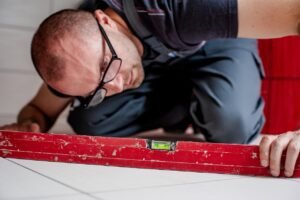
Why All Trades Secretly Hate Your Spirit Level
A brutally honest and highly suspicious investigation.
There are two types of spirit levels in this world:
- The ones tradespeople use.
- The one you bought from a bargain bin for £4.99 and proudly call “professional.”
And guess which one every trade hates?
Yep—yours.
Let’s explore the hidden reasons why plumbers, electricians, builders, and kitchen installers silently (and sometimes not-so-silently) loathe your spirit level.
1. Your Spirit Level Lies.
Tradespeople bring levels worth more than your microwave.
Levels that have:
- Precision-ground edges
- Calibrated vials
- Guaranteed accuracy
- Been blessed by the gods of carpentry
Your level, however, is…
optimistic.
It doesn’t measure straightness—
it measures vibes.
When your bubble says the shelf is level and the builder’s bubble disagrees, it’s not a debate.
Your bubble is wrong.
Your shelf is wrong.
Your level is wrong.
Life is wrong.
2. You Use It Like a Magic Wand
Trades have seen you do it:
You walk into the room, whip out your spirit level, and hold it up like you’re challenging their entire career.
“Aha! THIS doesn’t look straight!”
Meanwhile, you’re:
- Holding it at a weird angle
- Pressing it against paint drips
- Measuring something no one asked you to measure
- Balancing it on wallpaper (which is NOT structural, FYI)
That is not how levels work.
But bless your enthusiasm.
3. You Only Ever Use It to Prove Them Wrong
No homeowner has ever said:
“I’m just checking because I trust you.”
Instead, they say:
“Hmmm… this looks a bit off.”
“It doesn’t look level to me…”
“Is the bubble meant to be in the middle?”
“I saw on YouTube—”
STOP.
As far as trades are concerned, your level only emerges like a mythical beast when there’s suspicion in the air.
You don’t use it to help.
You use it to declare war.
4. Your Level Has Been Living in a Drawer for 10 Years
Tradespeople keep their levels in:
- Protective cases
- Padded toolboxes
- Clean, dry environments
Your spirit level has been stored in:
- A junk drawer
- With leaking batteries
- Tangled headphones
- Old takeaway menus
- And probably a melted candle
It’s a miracle the bubble even moves.
5. Your House Itself Is Not Level
This is the real kicker.
Your walls aren’t straight.
Your ceilings lean.
Your floors are shaped like gentle ski slopes.
Your house is basically wonky Tetris.
So when your spirit level tells you something’s off, it might be your house, not the tradesperson.
Builders know this.
You do not.
Your level definitely doesn’t.
6. You Assume “Level” Means “Looks Level to You”
Tradespeople work by millimetres.
Homeowners work by vibes.
To you:
“If it looks straight, it’s straight.”
To trades:
“If it’s 2mm out, we must correct the cosmic imbalance.”
This clash of values leads to hilarious arguments like:
“I swear that’s leaning.”
“No, your eyes are leaning.”
“Why does the wall look like that?”
“It’s been like that since 1973.”
Your level does not help these moments.
It inflames them.
7. Every Trade Knows: If You’re Holding a Level… You’re About to Make the Job Worse
If a homeowner steps onto the site holding a spirit level, every tradesperson instinctively knows:
“Here we go.”
Possible outcomes include:
- You remeasuring something already perfect
- You asking why the bubble wiggles
- You saying “It’s only a tiny bit off” while standing crooked
- You insisting a crooked wall be made straight (which requires magic, not carpentry)
- You asking how spirit levels work (again)
The job doesn’t just slow down—
it enters a new realm of chaos.
Final Thoughts: Trades Don’t Hate You… Just Your Level
Your spirit level is:
- Inaccurate
- Distressed
- Emotionally unreliable
- And probably older than the carpet
Trades don’t hate your enthusiasm.
They don’t hate your questions.
They don’t even hate your involvement.
They just hate the moment you show up holding that level with the same energy as someone presenting courtroom evidence.
So, the solution?
Let them use their level.
The mighty, calibrated, frequently checked, professional level.
And keep yours for its proper, noble purpose:
Opening paint cans.